From RFP to Proposal — AI That Does the Estimating Grind
Upload your spec book. Get WBS-classified scope packages, manage sub bids, and assemble your GC proposal — in hours, not weeks.
Human-in-the-loop: your estimators approve every classification.

What your estimating team faces on every bid
- Addenda, contracts, geotech reports: hundreds more pages arriving throughout the bid period
- Manual decomposition: reading every section, classifying by trade, building scope packages — by hand
- Proposal assembly: pulling it all together into a coherent GC response under deadline pressure
The result? Weeks of manual work per bid. Missed sections that become change orders. Sub bids that don't cover the full scope. Proposals that leave money on the table — or leave scope uncovered.
One pipeline, from the RFP landing to the proposal shipping
- 01UploadSpecs, drawings, addenda, contracts
- 02ClassifyEvery section mapped to your WBS, with a confidence score
- 03ReviewEstimators confirm in bulk and fix the edge cases
- 04PackageTrade scope packages, auto-built by division
- 05BidInvite subs, analyze coverage and exclusions
- 06ProposeGC response with coverage matrix and gap analysis
Built for the whole estimating workflow
Upload & Ingest
Drop in your spec PDFs, drawing sets, addenda, contracts, and geotech reports. The platform accepts PDF, DOCX, XLSX, PPTX, and images. Processing starts automatically.
AI Classification
A 7-phase AI pipeline extracts every spec section and classifies it against the industry-standard WBS format you bid against — 11 are supported, plus custom taxonomies. Each classification comes with a confidence score so your team knows exactly where to focus their review.
Human Review
Your estimators stay in control. Confirm high-confidence classifications in bulk, flag edge cases for discussion, and correct anything the AI got wrong. The AI does the heavy lifting; your team makes the final call.
Scope Package Generation
Bundle classified sections into trade-specific packages for subcontractor bidding. Auto-generate packages by division, then customize until the scope breakdown matches how you actually bid. Export each package as CSV, PDF, Word, or Markdown.
Drawing Analysis
A vision LLM analyzes every drawing page — extracting sheet metadata, general notes, keynotes, schedules, and material callouts. Cross-references between drawings and spec sections are mapped automatically.
Bid Management
Build your subcontractor directory across 29 standard construction trades. Invite subs to bid on specific scope packages. When bids come back, the AI analyzes each response for coverage, exclusions, alternates, qualifications, and risk flags — catching the buried exclusions that manual review misses.
Natural Language Query
Ask questions directly against your uploaded specs and drawings. Get AI-generated answers with source citations — spec section codes, drawing numbers, and page references.
Proposal Assembly
Assemble accepted sub bids into a complete GC proposal response with coverage matrix, gap analysis, per-trade narratives, and executive summary. Run a compliance check against the original RFP. Export as PDF or Word.
A 10-document municipal library bid set, decomposed
Screens from a public municipal library and parking garage project: specs, drawings and addenda in; classified sections, trade packages and cited answers out.
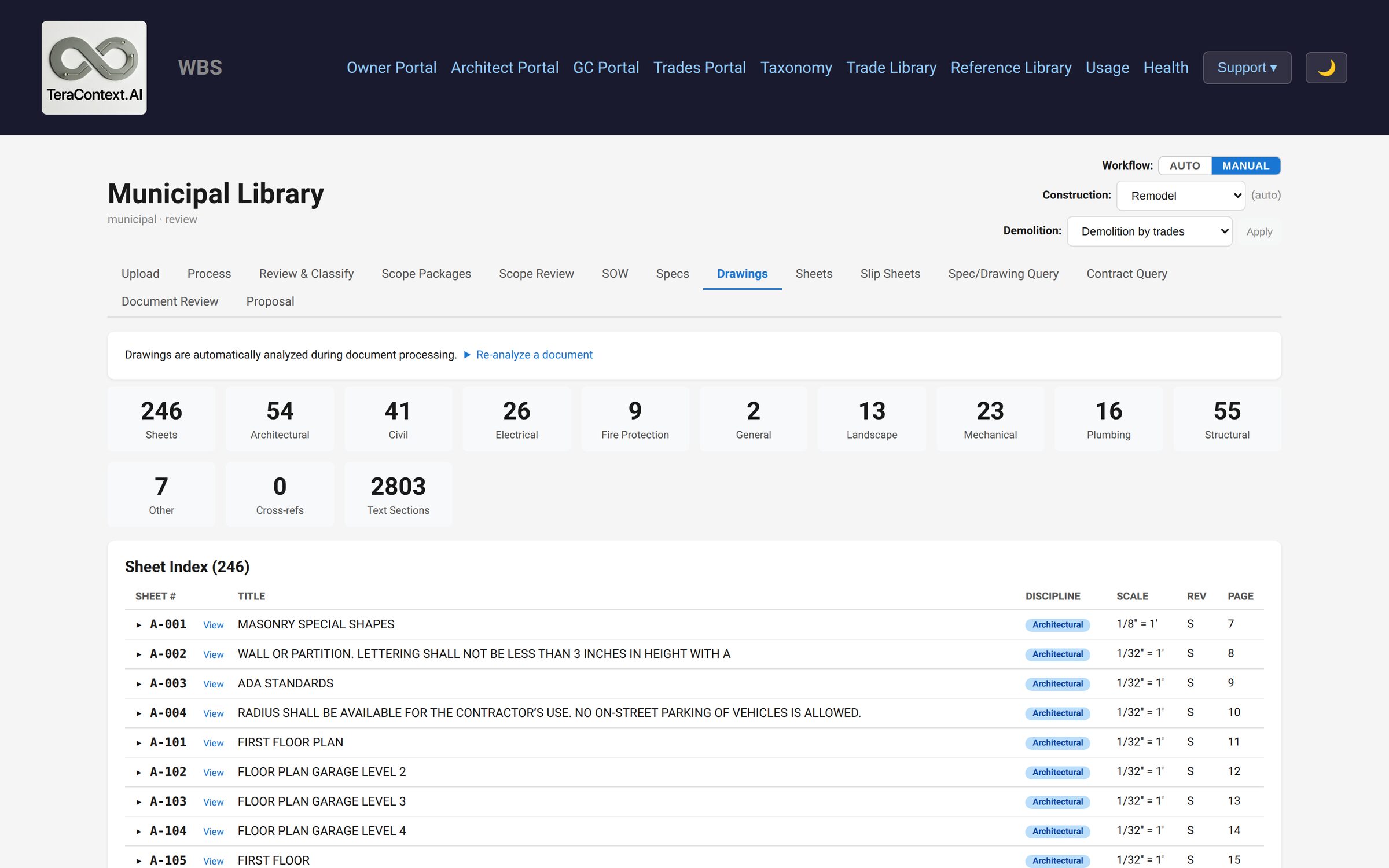
Every drawing sheet, indexed by discipline
246 sheets read by the vision model and sorted into architectural, civil, electrical, fire protection, landscape, mechanical, plumbing and structural — with sheet numbers, titles, scales and 2,803 extracted text sections.
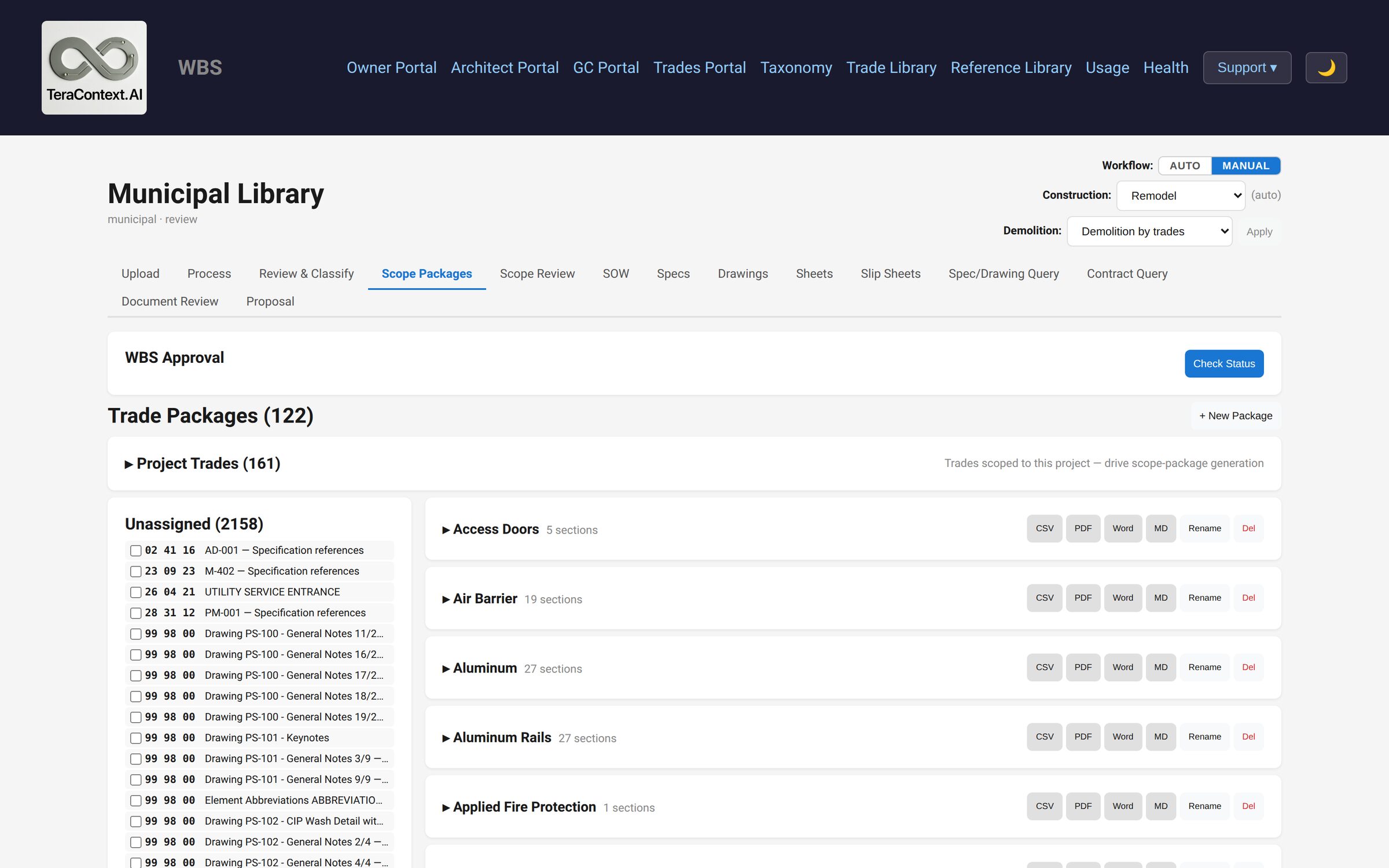
122 trade scope packages, ready to send
Classified sections roll up into trade packages you can rename, split and merge — then export for your subs in CSV, PDF, Word or Markdown.
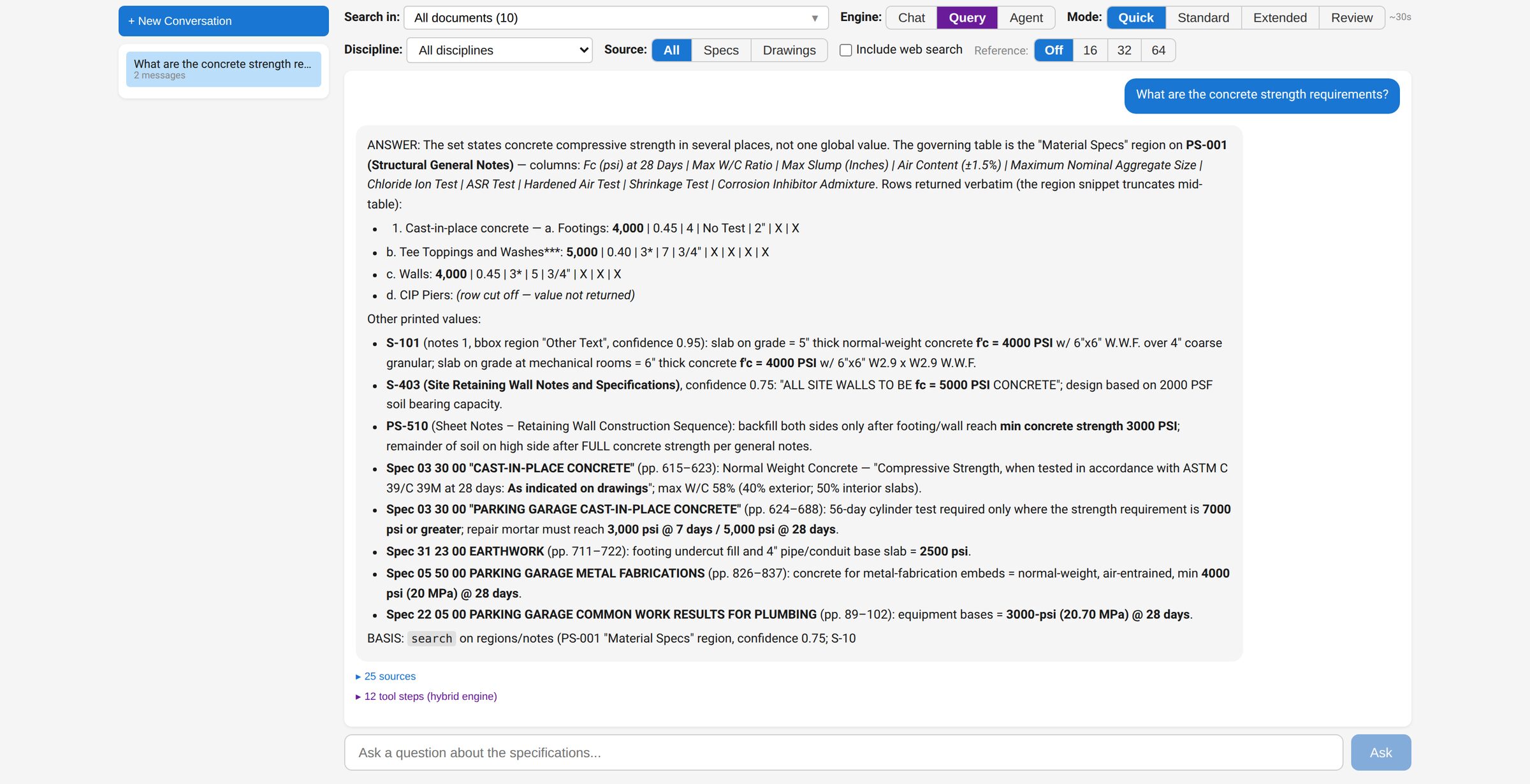
Ask the spec book. Get a cited answer.
"What are the concrete strength requirements?" comes back with the values from the structural general notes, individual sheets and four spec sections — each with its sheet number or page range.
11 industry-standard WBS formats — or your own
Works with open taxonomies such as UFGS, PennDOT-408, FERC Generation, DOE Nuclear and DOE Buildings, and customer-provided taxonomies such as the commercial spec division format, EPRI GN-COA and NAHB Residential — plus a custom taxonomy editor for firms with their own classification systems.
- Commercial spec divisions
- UFGS
- PennDOT-408
- FERC Generation
- EPRI GN-COA
- DOE Nuclear
- DOE Buildings
- NAHB Residential
- + Custom taxonomies
All major project types
Multi-Family, Office, Municipal, Parking, Retail, Hotel, Strip Mall, Mixed Use, and more.
A specialized AI pipeline
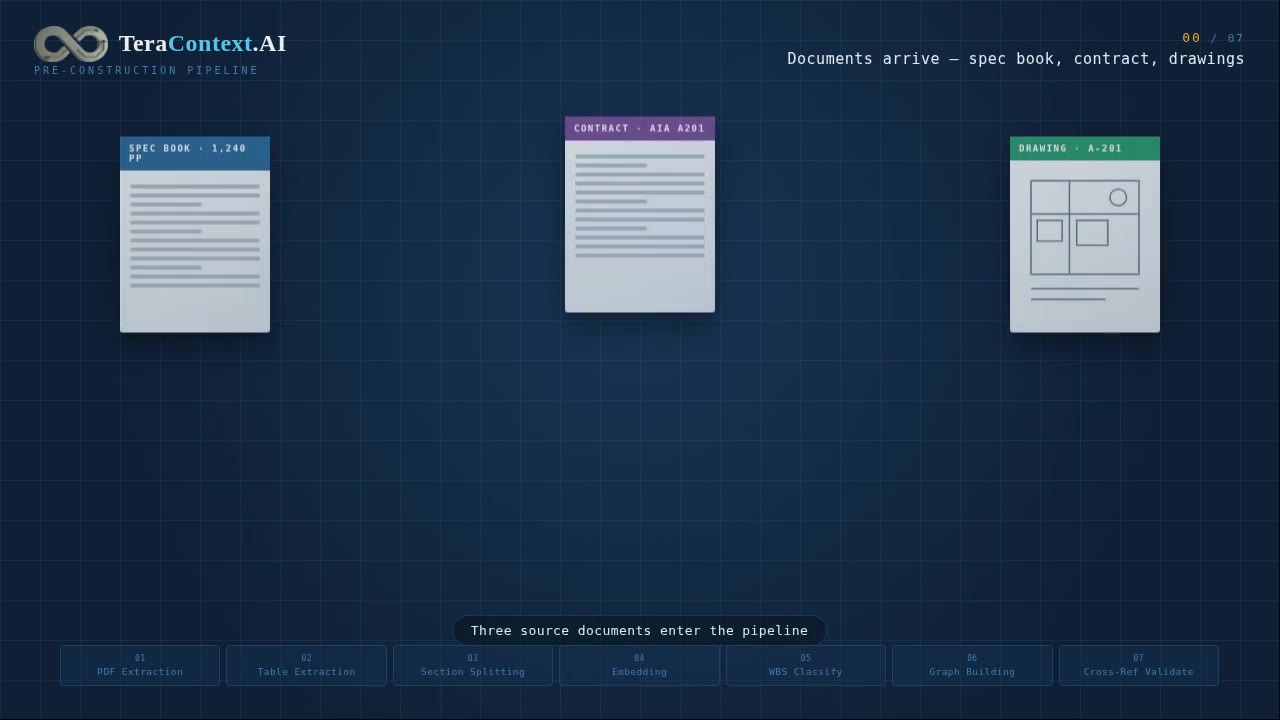
Seven phases — PDF extraction, table extraction, section splitting, embedding, WBS classification, graph building, cross-reference validation — purpose-built for construction documents, not adapted from a generic document tool.
Purpose-built for the bid desk
Construction-specific WBS classification
Not generic document tagging, but purpose-built for industry-standard WBS formats and construction specification structure.
Human-in-the-loop review
AI does the heavy lifting, but your estimators approve every classification before scope packages are built.
End-to-end workflow
From the moment the RFP lands to the moment your proposal ships, in one platform.
Bid response intelligence
AI-powered analysis of sub bid documents catches exclusions and gaps that manual review misses.
Part of the Joshua8.AI product line, built in McLean, VA.
One set of documents, every seat at the table
Watch all the role videos, plus the affordable housing view →
Latest on spec risk and bid strategy
-
 AI for Documents
The Steam Shovel Moment for Civil Engineering Drafting
Three AI agents got the same week-long Civil 3D homework: Claude Opus finished in 65 minutes, unattended; two local Qwen runs stalled.
Read the post
AI for Documents
The Steam Shovel Moment for Civil Engineering Drafting
Three AI agents got the same week-long Civil 3D homework: Claude Opus finished in 65 minutes, unattended; two local Qwen runs stalled.
Read the post
-
 Data Centers
The On-Ramp Is Gas. The Destination Is Still Nuclear.
One Nvidia rack is now specified at about 600 kW. Gas turbines win the next five years of power while SMRs win permits, reshaping nuclear engineering.
Read the post
Data Centers
The On-Ramp Is Gas. The Destination Is Still Nuclear.
One Nvidia rack is now specified at about 600 kW. Gas turbines win the next five years of power while SMRs win permits, reshaping nuclear engineering.
Read the post
-
 AI for Documents
Two AIs, One Subdivision, Ninety Minutes
Grok and Claude each laid out a 20-lot Civil 3D subdivision from a one-line prompt in 45 minutes. One solved it; one only looked finished.
Read the post
AI for Documents
Two AIs, One Subdivision, Ninety Minutes
Grok and Claude each laid out a 20-lot Civil 3D subdivision from a one-line prompt in 45 minutes. One solved it; one only looked finished.
Read the post
Is TeraContext.AI Right For You?
We are a fit if…
- Your estimating team processes RFPs with 500+ page spec books
- Manual spec decomposition and scope packaging takes your team days or weeks
- You manage subcontractor bidding across many trades per project
- Missed scope and incomplete coverage are costing you on change orders
- You need to respond to multiple RFPs simultaneously
We may not be a fit if…
- You're a small residential contractor without complex spec books
- Your projects don't involve multi-trade subcontractor bidding
- You have fewer than 100 pages of specifications per project